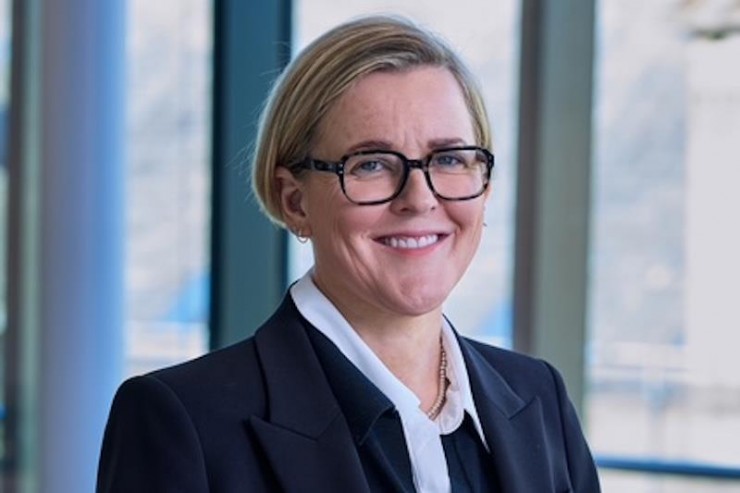
Former Channel 4 specialist factual commissioner Fatima Salaria has accused the broadcaster of “turning abuse into a style choice” by broadcasting its documentary about porn actor Bonnie Blue.
Salaria, executive chair of the Edinburgh TV Festival, wrote on LinkedIn that there is “no justification” for the “platforming” of Blue in Magnificent Pictures’ 85-minute doc 1,000 Men and Me: the Bonnie Blue Story, which aired last week.
Salaria’s comments followed yesterday’s Sunday Times report stating that advertisers Visa, Smirnoff and Cawston Press have pulled advertising around the programme on channel4.com because it does not align with their values.
The paper also questioned the ease with which teens could access the doc on the site via a ‘tick to confirm you are 18’ box, and whether explicit scenes, while pixellated, were sufficiently justified by context and challenged by the progamme-makers.
'We have to do better'
“We don’t need to ‘understand’ her world,” Salaria wrote. “We don’t need to fake interrogate her choices. We certainly don’t need to amplify a voice that glamorises violence against women under the guise of journalism. OnlyFans banned her, does that not tell us something?
“This isn’t about advertisers pulling out. They’ll be back. The real issue is what we choose to commission in the first place. Whose voices we centre. What kind of gaze we validate. And what message that sends, especially to young people already struggling to navigate a culture saturated with misogyny…
“This documentary doesn’t challenge anything. It aestheticises harm. It turns abuse into a style choice. And by broadcasting it, we say, this is worthy. This deserves airtime. This is what we think people should hear.
“We can do better. We have to do better. Not just for the sake of victims and survivors but for the kind of media culture we’re building. One that’s not performatively provocative, but truly principled. One that protects instead of parades. One that knows the difference between storytelling and spectacle.”
Salaria contrasted the doc with BBC3’s 2002 series Planet Sex with Cara Delavigne, which she executive produced when she was managing director at Naked.
That series, she said, was empowering as it was “grounded in empathy and integrity” and “did not glamorise abuse [or] validate misogyny”.
'Surprising lack of judgement'
Children’s commissioner Dame Rachel de Souza criticised C4 over the doc, telling the Sunday Times: “For years we have been fighting to protect our children from the kind of degrading, violent sex that exists freely on their social media feeds.
“This documentary risks taking us a step back by glamorising, even normalising, the things young people tell me are frightening, confusing and damaging to their relationships.”
Meanwhile, Conservative peer Baroness Bertin, who led the government’s independent review of the regulation of online pornography, said C4 showed a “surprising lack of judgement” in showing explicit sex scenes in the documentary.
“More widely, the glamorisation and normalisation of content creators like Bonnie Blue does undoubtedly have an effect. In my opinion, this is a direction of travel that is not particularly helpful for society nor is it prudish to call it out as such.”
C4 defence
C4 chief content officer Ian Katz defended the documentary for addressing a topic that is “clearly a legitimate subject”.
Responding to critics, he said director Victoria Silver challenged Blue’s actions.
“I think a huge proportion of the audience would be deeply horrified by what they saw and reach their own conclusions,” he said.
“Judging an observational documentary by the standards of an accountability interview is pointless — it’s a completely different type of broadcasting.”