Importing credits is a nightmare 🫠
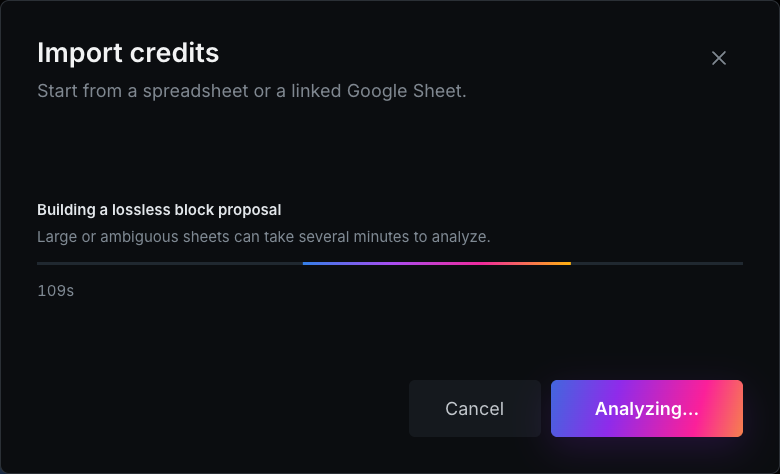
I’ve been spending a lot of time working on document import in Edit Credits.
At first, it sounded easy: take a spreadsheet, find the roles and names, turn them into credits. Done.
... Read more
Importing credits is a nightmare 🫠
I’ve been spending a lot of time working on document import in Edit Credits.
At first, it sounded easy: take a spreadsheet, find the roles and names, turn them into credits. Done.
Obviously, that was extremely optimistic.
Every credits document seems to follow its own private religion. 🙏
Sometimes roles and names are in separate columns. Sometimes five people share one role. Sometimes an empty row starts a new section. Sometimes it means absolutely nothing. Companies, actors, technical notes, music, legal text and random comments can all live in the same spreadsheet.
My first approach didn’t use an LLM. I tried to understand everything through rows, columns, spacing and formatting.
It worked surprisingly well — right up until I opened the next spreadsheet.
So I added an LLM. 🤖
That helped, but “send the spreadsheet to the AI and hope for the best” is not exactly a reliable product strategy.
The model can understand 95% of a document and then suddenly decide that Director of Photography is a section title, a production comment is somebody’s name, and one actor simply never existed.
I’m now using a hybrid approach. The LLM tries to understand the meaning and structure of the document, while the rest of the system checks that nothing disappeared, roles still belong to the right people, and the result can actually be edited.
It’s getting much better. I’ve tested it on quite a few real documents, but more variety would be very useful.
📄 If you have a working credits document from a film, series, commercial, music video or anything similar, I’d love to test it.
Excel, Google Sheets, Word, PDF — clean or messy, both are useful.
You can remove or replace anything confidential. I mostly care about the structure and all the strange ways people organise credits in real life.
If you have one and feel like sharing it, that would be really cool — and very helpful for the project. 🙌
I’ve been spending a lot of time working on document import in Edit Credits.
At first, it sounded easy: take a spreadsheet, find the roles and names, turn them into credits. Done.
Obviously, that was extremely optimistic.
Every credits document seems to follow its own private religion. 🙏
Sometimes roles and names are in separate columns. Sometimes five people share one role. Sometimes an empty row starts a new section. Sometimes it means absolutely nothing. Companies, actors, technical notes, music, legal text and random comments can all live in the same spreadsheet.
My first approach didn’t use an LLM. I tried to understand everything through rows, columns, spacing and formatting.
It worked surprisingly well — right up until I opened the next spreadsheet.
So I added an LLM. 🤖
That helped, but “send the spreadsheet to the AI and hope for the best” is not exactly a reliable product strategy.
The model can understand 95% of a document and then suddenly decide that Director of Photography is a section title, a production comment is somebody’s name, and one actor simply never existed.
I’m now using a hybrid approach. The LLM tries to understand the meaning and structure of the document, while the rest of the system checks that nothing disappeared, roles still belong to the right people, and the result can actually be edited.
It’s getting much better. I’ve tested it on quite a few real documents, but more variety would be very useful.
📄 If you have a working credits document from a film, series, commercial, music video or anything similar, I’d love to test it.
Excel, Google Sheets, Word, PDF — clean or messy, both are useful.
You can remove or replace anything confidential. I mostly care about the structure and all the strange ways people organise credits in real life.
If you have one and feel like sharing it, that would be really cool — and very helpful for the project. 🙌