The UK’s multichannel era roughly 1998 to the mid 2010s produced tightly branded digital spin off channels.BBC Three, BBC Four, E4, More4, ITV2, 3, and 4 each had a distinct on screen identity that shaped what audiences expected to find there. 📡Those brands did real work. They signalled tone, target audience, and programme type when linear schedules and channel surfing still dominated discovery.Viewing journeys have shifted substantially since.We now all stream, and in that world... Read more
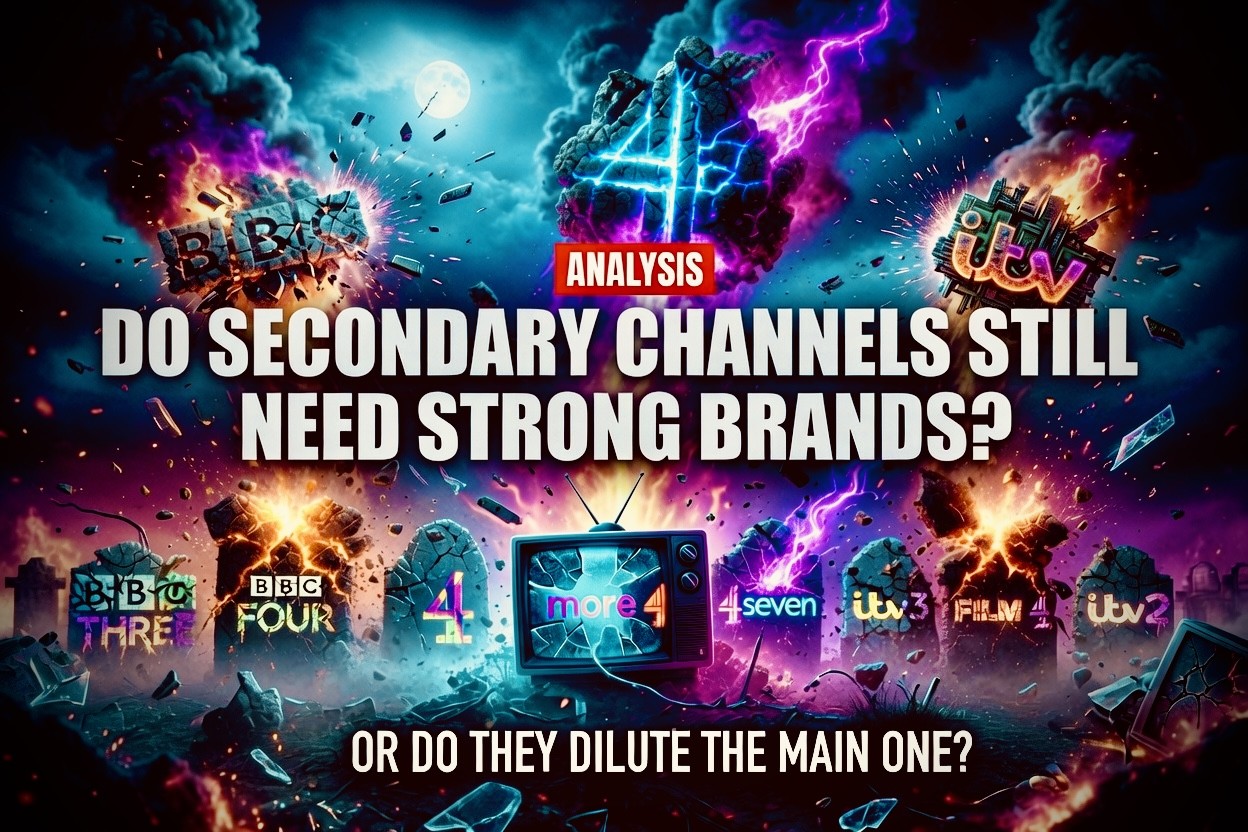
The UK’s multichannel era roughly 1998 to the mid 2010s produced tightly branded digital spin off channels.
BBC Three, BBC Four, E4, More4, ITV2, 3, and 4 each had a distinct on screen identity that shaped what audiences expected to find there. 📡
Those brands did real work. They signalled tone, target audience, and programme type when linear schedules and channel surfing still dominated discovery.
Viewing journeys have shifted substantially since.
We now all stream, and in that world we don’t really need traditional channels in the same way. 📱
Some secondary channels still carry real emotional resonance for long time viewers. BBC Four’s arts and documentary reputation is a clear example, surviving multiple funding reviews precisely because of that association. 🎭
But recommendation algorithms now drive a substantial share of discovery, increasingly finding the right viewer for the right programme without a distinctive channel brand doing that work directly. 🔍
Pure streamers show the new model clearly
Netflix doesn’t present sub brands. You log in and see categories: film, crime, gameshows, comedy, all under one Netflix brand.
Amazon, Apple TV+, and Disney+ follow suit: one master brand, clear genre organisation, and algorithms doing the heavy lifting. 🎬
UK broadcasters have adapted unevenly.
ITVX carries the main ITV channels plus a changing roster of FAST themed sub channels. Launched with many, rationalised in 2023, then leaned back in with more focused ones for lean back viewing.
Yet its on demand library is organised by genre (Drama, Comedy, Films, Reality, Kids, Sport, Documentaries) plus curated rails like Top Picks and Fresh In, not by those sub channels.
Channel 4 still has E4, More4, Film4, 4seven, and E4 Extra, and has leaned into exclusive FAST channels on Freely. But the streaming service itself leans on genres, collections, and curated rails.
The BBC has been more restrained, with a few quiet themed iPlayer streams alongside a classic, category driven experience.
What actually works now
Secondary and FAST style channels still have a role for continuous, scheduled, lean back viewing and long term brand associations.
But they’re no longer the primary way audiences navigate content. ✅
Strong master brands plus smart categorisation and algorithms do that job more efficiently, with less dilution risk.
Secondary channels don’t automatically dilute the main brand. But done as the default organising system in a streaming world, they risk becoming noise.
💬 Is it still worth investing in distinct sub brands, or is one clear master brand plus genres the smarter play?
I personally think the wind is blowing towards super strong single brands.
But interested in thoughts?💭
I drop content a day early on my free substack which covers MediaTech\AI\Web3 :
https://nicknmedia.substack.com
And all the media related ones get posted on this site so you can read them here.
BBC Three, BBC Four, E4, More4, ITV2, 3, and 4 each had a distinct on screen identity that shaped what audiences expected to find there. 📡
Those brands did real work. They signalled tone, target audience, and programme type when linear schedules and channel surfing still dominated discovery.
Viewing journeys have shifted substantially since.
We now all stream, and in that world we don’t really need traditional channels in the same way. 📱
Some secondary channels still carry real emotional resonance for long time viewers. BBC Four’s arts and documentary reputation is a clear example, surviving multiple funding reviews precisely because of that association. 🎭
But recommendation algorithms now drive a substantial share of discovery, increasingly finding the right viewer for the right programme without a distinctive channel brand doing that work directly. 🔍
Pure streamers show the new model clearly
Netflix doesn’t present sub brands. You log in and see categories: film, crime, gameshows, comedy, all under one Netflix brand.
Amazon, Apple TV+, and Disney+ follow suit: one master brand, clear genre organisation, and algorithms doing the heavy lifting. 🎬
UK broadcasters have adapted unevenly.
ITVX carries the main ITV channels plus a changing roster of FAST themed sub channels. Launched with many, rationalised in 2023, then leaned back in with more focused ones for lean back viewing.
Yet its on demand library is organised by genre (Drama, Comedy, Films, Reality, Kids, Sport, Documentaries) plus curated rails like Top Picks and Fresh In, not by those sub channels.
Channel 4 still has E4, More4, Film4, 4seven, and E4 Extra, and has leaned into exclusive FAST channels on Freely. But the streaming service itself leans on genres, collections, and curated rails.
The BBC has been more restrained, with a few quiet themed iPlayer streams alongside a classic, category driven experience.
What actually works now
Secondary and FAST style channels still have a role for continuous, scheduled, lean back viewing and long term brand associations.
But they’re no longer the primary way audiences navigate content. ✅
Strong master brands plus smart categorisation and algorithms do that job more efficiently, with less dilution risk.
Secondary channels don’t automatically dilute the main brand. But done as the default organising system in a streaming world, they risk becoming noise.
💬 Is it still worth investing in distinct sub brands, or is one clear master brand plus genres the smarter play?
I personally think the wind is blowing towards super strong single brands.
But interested in thoughts?💭
I drop content a day early on my free substack which covers MediaTech\AI\Web3 :
https://nicknmedia.substack.com
And all the media related ones get posted on this site so you can read them here.