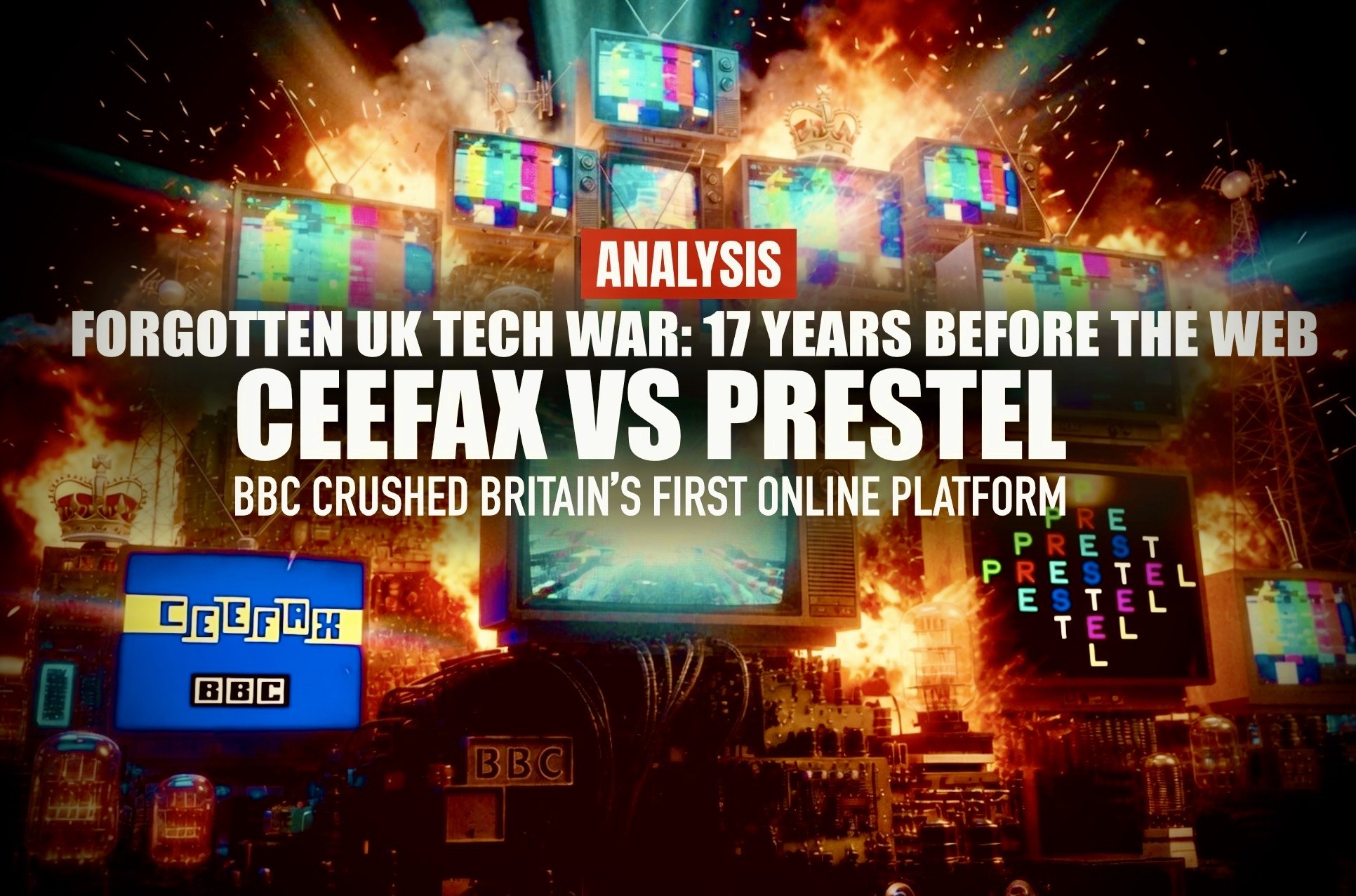
Forgotten UK Tech War: 17 Years Before the Web. Ceefax vs Prestel.17 years before the World Wide Web, the BBC beat everyone to it.In the early 1970s, people relied on newspapers, radio and TV bulletins for news and weather. There was no on demand access.The BBC spotted a gap: unused space in the TV signal, and used it to broadcast text pages. This created Ceefax, a free service letting viewers call up news, prices, recipes and TV listings at the press of a button. It launched on 23... Read more
Forgotten UK Tech War: 17 Years Before the Web. Ceefax vs Prestel.
17 years before the World Wide Web, the BBC beat everyone to it.
In the early 1970s, people relied on newspapers, radio and TV bulletins for news and weather. There was no on demand access.
The BBC spotted a gap: unused space in the TV signal, and used it to broadcast text pages. This created Ceefax, a free service letting viewers call up news, prices, recipes and TV listings at the press of a button. It launched on 23 September 1974, genuinely groundbreaking engineering. ✅
📞 The Post Office answered with something far more ambitious: Prestel. Launched in 1979, it required a phone line but was genuinely interactive, you dialled into a computer, browsed pages, sent messages, booked holidays and even did basic banking. 💳
This made Prestel years ahead of its time. Travel agents checked flight availability, estate agents listed property, and businesses sent early email between terminals, arguably Britain’s first online platform. 🌍
Onscreen, Prestel and Ceefax used an almost identical colour palette and blocky text, a conscious choice for cross comparability. But to consumers, this just made Prestel look like an expensive Ceefax.
💰 And it was cost that killed it for ordinary homes. Renting a Prestel set cost roughly £18 to £30 a month, plus subscription and call charges, a typical bill of £21 to £38 in 1979, around £250 today.
Ceefax cost nothing once you owned a decoder equipped TV. No phone bills, no subscriptions, just free information whenever you wanted it. 🆓
🚀 That price gap decided the winner. Ceefax reached millions of homes, effortless and free, while Prestel stayed a niche tool for businesses. By the early 1990s the Web was rising, and Prestel shut in 1994 after BT sold the service. 📴
📈 Other channels joined the party. ITV launched ORACLE, then Channel 4 and Five joined via Teletext Ltd, all keeping it free for viewers, with advertisers paying instead. It worked: teletext was genuinely profitable, ad revenue was predicted near £50 million by 1985, and Teletext Holidays alone once sold one in ten UK holidays. At its peak, over 20 million Britons used it weekly.
🤔 What should Prestel have done? Gone cheaper, ideally free, and opened to personal computers sooner. Could it have survived the Web anyway? Almost certainly not, it was closed and proprietary, the Web was open and global. 🌐
📌 The lessons still apply today. Free access paired with real simplicity beats clever but expensive tech, and convenience matters more than features few will pay for.
This is why AOL built its late 1990s strategy around a freemium model: give away the basics, monetise the extras. Streaming and AI tools run the same playbook today. 💡
So here’s the thought worth sitting with: innovative tech rarely dominates on features alone. Simplicity, price and timing matter, and the Post Office learned that the hard way.
#Ceefax #Prestel #Teletext #InternetHistory #TechLessons
17 years before the World Wide Web, the BBC beat everyone to it.
In the early 1970s, people relied on newspapers, radio and TV bulletins for news and weather. There was no on demand access.
The BBC spotted a gap: unused space in the TV signal, and used it to broadcast text pages. This created Ceefax, a free service letting viewers call up news, prices, recipes and TV listings at the press of a button. It launched on 23 September 1974, genuinely groundbreaking engineering. ✅
📞 The Post Office answered with something far more ambitious: Prestel. Launched in 1979, it required a phone line but was genuinely interactive, you dialled into a computer, browsed pages, sent messages, booked holidays and even did basic banking. 💳
This made Prestel years ahead of its time. Travel agents checked flight availability, estate agents listed property, and businesses sent early email between terminals, arguably Britain’s first online platform. 🌍
Onscreen, Prestel and Ceefax used an almost identical colour palette and blocky text, a conscious choice for cross comparability. But to consumers, this just made Prestel look like an expensive Ceefax.
💰 And it was cost that killed it for ordinary homes. Renting a Prestel set cost roughly £18 to £30 a month, plus subscription and call charges, a typical bill of £21 to £38 in 1979, around £250 today.
Ceefax cost nothing once you owned a decoder equipped TV. No phone bills, no subscriptions, just free information whenever you wanted it. 🆓
🚀 That price gap decided the winner. Ceefax reached millions of homes, effortless and free, while Prestel stayed a niche tool for businesses. By the early 1990s the Web was rising, and Prestel shut in 1994 after BT sold the service. 📴
📈 Other channels joined the party. ITV launched ORACLE, then Channel 4 and Five joined via Teletext Ltd, all keeping it free for viewers, with advertisers paying instead. It worked: teletext was genuinely profitable, ad revenue was predicted near £50 million by 1985, and Teletext Holidays alone once sold one in ten UK holidays. At its peak, over 20 million Britons used it weekly.
🤔 What should Prestel have done? Gone cheaper, ideally free, and opened to personal computers sooner. Could it have survived the Web anyway? Almost certainly not, it was closed and proprietary, the Web was open and global. 🌐
📌 The lessons still apply today. Free access paired with real simplicity beats clever but expensive tech, and convenience matters more than features few will pay for.
This is why AOL built its late 1990s strategy around a freemium model: give away the basics, monetise the extras. Streaming and AI tools run the same playbook today. 💡
So here’s the thought worth sitting with: innovative tech rarely dominates on features alone. Simplicity, price and timing matter, and the Post Office learned that the hard way.
#Ceefax #Prestel #Teletext #InternetHistory #TechLessons