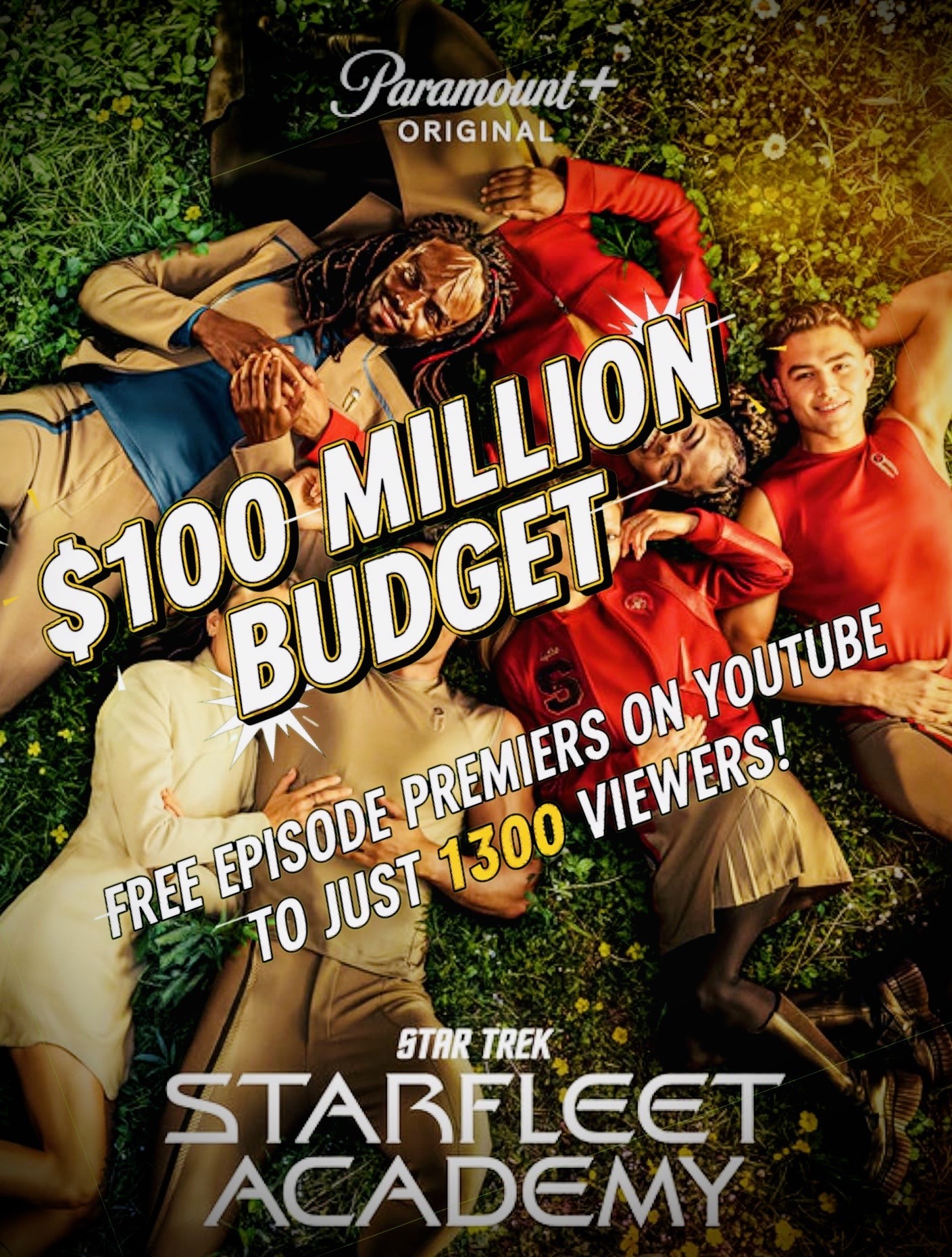
Paramount has attempted a bold experiment with its new $100 million budgeted Star Trek series, Starfleet Academy.The first episode was released for free on YouTube to American audiences.
Just 1,300 people joined the live stream, with only 16,000 views accumulated over the following 11 hours.To put that into perspective in the U.S.:* Star Trek: Voyager premiered to 21.3 million viewers in 1995.
* Star Trek: The Next Generation drew over 30 million viewers for its series finale in 1994.... Read more
Paramount has attempted a bold experiment with its new $100 million budgeted Star Trek series, Starfleet Academy.
The first episode was released for free on YouTube to American audiences.
Just 1,300 people joined the live stream, with only 16,000 views accumulated over the following 11 hours.
To put that into perspective in the U.S.:
* Star Trek: Voyager premiered to 21.3 million viewers in 1995.
* Star Trek: The Next Generation drew over 30 million viewers for its series finale in 1994.
Even accounting for modern viewing habits, these are extremely poor numbers. That said, Paramount deserves some credit for experimenting with a YouTube release.
However, matters are made worse by the fact that YouTubers reviewing the show are pulling in more views than the episode itself… some exceeding five times the show’s actual audience.
Normally, streaming viewership figures are released only at the discretion of the streamer. YouTube, however, is fully transparent with its view counts. This makes the model risky: it doesn’t just allow for failure…it publicly broadcasts it. That alone may discourage other shows from following this approach.
So why did this happen?
First, there has been a significant drop off in the Star Trek fan base as recent shows have chased so called “modern audiences,” often alienating their core viewers in the process.
Many fans see the series heading down the same path as Doctor Who.. prioritising identity politics and messaging over entertainment. Star Trek has always used science fiction to reflect society, but recent entries have become increasingly heavy handed, lacking the subtlety and nuance that defined 1990s Trek.
Critics tend to score these ‘modern’ shows highly on Rotten Tomatoes (around 85%), while audiences respond very differently.. reflected in an audience score closer to 35%.
Lastly, the trailers simply don’t look very compelling. The lone bright spot for many fans is the return of Robert Picardo, reprising his role as the holographic Doctor from the 1990s era.
Despite all this, Season 2 has already been greenlit.
And it wouldn’t be the first time a Star Trek series started poorly before eventually finding a loyal audience.
But if a show can’t attract viewers even when it’s offered for free, it raises serious questions about the viability of the franchise in its current form.
The first episode was released for free on YouTube to American audiences.
Just 1,300 people joined the live stream, with only 16,000 views accumulated over the following 11 hours.
To put that into perspective in the U.S.:
* Star Trek: Voyager premiered to 21.3 million viewers in 1995.
* Star Trek: The Next Generation drew over 30 million viewers for its series finale in 1994.
Even accounting for modern viewing habits, these are extremely poor numbers. That said, Paramount deserves some credit for experimenting with a YouTube release.
However, matters are made worse by the fact that YouTubers reviewing the show are pulling in more views than the episode itself… some exceeding five times the show’s actual audience.
Normally, streaming viewership figures are released only at the discretion of the streamer. YouTube, however, is fully transparent with its view counts. This makes the model risky: it doesn’t just allow for failure…it publicly broadcasts it. That alone may discourage other shows from following this approach.
So why did this happen?
First, there has been a significant drop off in the Star Trek fan base as recent shows have chased so called “modern audiences,” often alienating their core viewers in the process.
Many fans see the series heading down the same path as Doctor Who.. prioritising identity politics and messaging over entertainment. Star Trek has always used science fiction to reflect society, but recent entries have become increasingly heavy handed, lacking the subtlety and nuance that defined 1990s Trek.
Critics tend to score these ‘modern’ shows highly on Rotten Tomatoes (around 85%), while audiences respond very differently.. reflected in an audience score closer to 35%.
Lastly, the trailers simply don’t look very compelling. The lone bright spot for many fans is the return of Robert Picardo, reprising his role as the holographic Doctor from the 1990s era.
Despite all this, Season 2 has already been greenlit.
And it wouldn’t be the first time a Star Trek series started poorly before eventually finding a loyal audience.
But if a show can’t attract viewers even when it’s offered for free, it raises serious questions about the viability of the franchise in its current form.