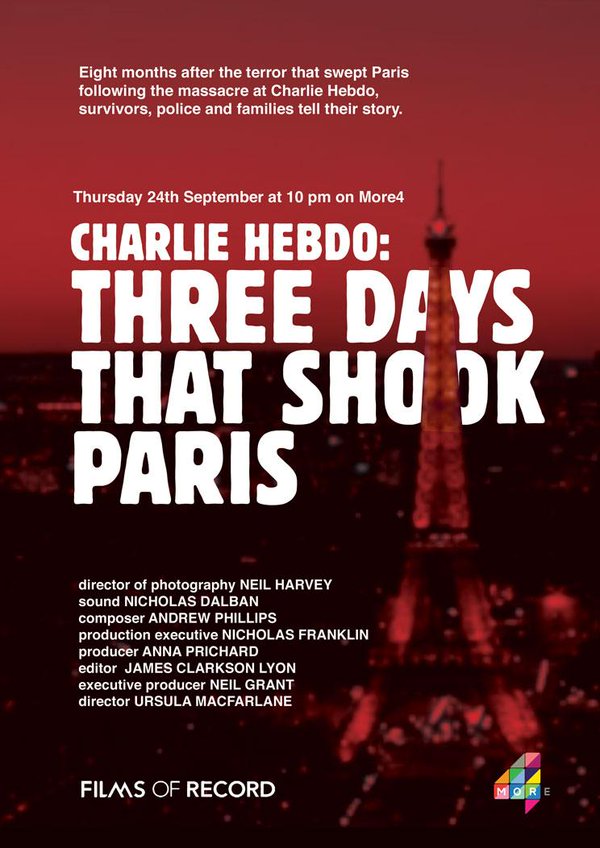
Ursula is nominated for 'Television Craft: Director - Factual' for her role in Charlie Hebdo: Three Days That Shook Paris, a revealing documentary surrounding the January 2015 terror attacks on the satirical magazine. Here, she talks to us about the making of the doc.
When Neil Grant at Films of Record called me to tell me about the commission, I didn’t hesitate: I speak French and have spent long periods of time in Paris, so the city is very close to my heart, and the pain it was going through was heartbreaking. Making the film would mean a lot to me.
The film was greenlit by Anna Miralis within only two months of the atrocities in Paris. Anna wanted the channel wanted to be the very first broadcaster to address the January events in a long-form. So our first challenge was to provide a journalistically rigorous and emotionally truthful testament to the attacks, in a relatively short space of time.
One of our priorities was to tell the untold, inside story of the police investigation,and so I and my producer Anna Prichard began to cultivate relationships with police advisors, journalists and Ministry of Interior and Gendarmerie officials. At the same time, we were forging relationships with members of the Muslim and Jewish communities, as well as with witnesses to the events on the streets of Paris and in the small town of Dammartin where the Kouachi brothers eventually holed up.
It was a huge challenge to gain the trust of survivors, witnesses and the bereaved.
Of course, they were still immersed in a world of trauma and loss, and still had terrible images in their heads. The surviving staff members of Charlie Hebdo were still too traumatised to talk. We didn’t want to push anybody, but spent a lot of time meeting and building the trust of others who told us that they were beginning to feel ready to talk.
We wanted everyone to feel comfortable and safe with us. This was a very uncertain time - contributors felt threatened and suspicious, especially members of the Jewish community, about how sensitively we would tell their individual stories. We didn’t start filming until everyone assured us they were ready.
Some, like Michel Catalano, owner of the Dammartin printworks, felt that it would help him in his recovery to recount the events of that day, and he opened up the factory to us, the only non-news crew to be allowed in.
We wanted viewers to become completely immersed in the unfolding of these shocking three days. There were no ‘talking heads’ – we filmed only people directly involved in the events. We didn’t set out to explain or analyse events unless this emerged organically from news archive, which could serve almost as a Greek chorus.
To keep the audience gripped, we created one world in which past archive, testimony and observational material could co-exist. So, for example, we took Charlie Hebdo columnist Patrick Pelloux back to his office, the scene of the massacre, for the first time, matching his testimony to stills of the aftermath of the murders, and archive footage of the emergency services arriving in the streets below.
The film was shot by DOP Neil Harvey on the Arri Amira with a greyish, bleached-out look to match the archive filmed on those grey January days in 2015. Out on the streets of Paris, we wanted to evoke a sense of a city caught up in a nightmare, a city on alert. While a counter-terrorism officer talked about how the public was at risk of further attacks, we filmed passers-by on Parisian streets at 200 frames per second to give an almost hallucinatory feel. Unfortunately, his words were horribly prescient; it now feels like Charlie Hebdo was just the beginning.
I know that many of us feel powerless in the face of these events – I certainly do – and I think it’s really important that we filmmakers continue to try to make sense of them, and give a voice to those involved, on all sides.
Watch this clip taken from Ursula's website
Ursula is nominated for Director - Factual for her role in 'Charlie Hebdo: Three Days That Shook Paris', as is the Editor James Clarkson Lyon for Editor - Factual. The BAFTA Craft Awards are Sunday 24th April, you can catch online coverage on the BAFTA website.
Ursula Macfarlane
Ursula is nominated for Director - Factual for her role in 'Charlie Hebdo: Three Days That Shook Paris'. View Ursula Macfarlane's Talent Manager profile here.