As a documentary filmmaker, you know that the presence of a camera always changes the reality you are trying to portray, and in certain circumstances it might even change the course and outcome of the whole edifice of the story. This reality always sparks heated debate which can sometimes overshadow the actual subject of the documentary.
I´ll return to this point later. First, a brief outline of the issues depicted in my documentary film ”Law of The Jungle”.
The Peruvian government has outsourced a major part of its resources to mining and oil companies which in recent times has led to confrontations with the indigenous people who have occupied these areas for generations.
Some of these companies have ruined the lifestyles of the indigenous and acted with impunity.
When the indigenous rise up, they demand that the companies exploiting the land start to contribute to the local community, instead of destroying it. In response, the companies often collaborate with the government and the special police forces in order to protect their interests and criminalize the actions of the protesters.
Although the government recognizes the indigenous´ right to ancestral hunting lands, it maintains that what is beneath the surface belongs to the government. Special police forces are often engaged to protect the oil companies´ installations.
Consequently, it is not the oil company, but rather the police, that engages with the angry indigenous protesters. Often this confrontation results in the arrest of indigenous leaders and it is at this point that the legal charade begins, well away from the public glare.
The indigenous are of course penniless and unable to pay for legal representation. They often appear in court without a lawyer. In the Peruvian system, legally aided assigned counsel have a bad reputation and are often seen as worthless. In stark contrast, the government is represented by a professional prosecutor. There are also civil parties who, in most of these incidents, represent the interests of the police and the oil company.
From the outset, the odds are stacked against the indigenous. This process has nothing to do with the rule of law or justice. The normal outcome is that the indigenous will end up rotting in lousy prisons. It´s a scam, it’s a sham and it’s still going on.
In collaboration with the government, the oil companies and the police are complicit in the concealment of their own crimes and the gross pollution of the land. The criminal code is used as a weapon against the indigenous, but not against the companies. It´s all very carefully calculated.
By labeling the protesters as criminals and keeping these social conflicts in the courtrooms, the oil companies can avoid being counter sued by the indigenous and their organizations. The reality of this cover-up is however, starting to emerge.
A new generation of indigenous leaders can read and write. They are educated. They speak Spanish as well as one or two tribal languages and know about the power of the media and that globalization can bring their remote conflict to the rest of the world.
And that´s what happened when colleagues of mine visited Iquitos in Peru, where a group of more than 20 indigenous so-called leaders were in prison following a confrontation with the special police after a protest on Plus Petrol´s air strip. The protesters were complaining about the oil company´s pollution of their water streams and hunting grounds. They handed over to my colleagues hours of video footage documenting both the pollution and the protest. This intriguing material lured us into this dramatic confrontation in the Amazon jungle.
And here I come back to my starting point. We began to film this indigenous group of people and their legal battle against mighty opponents; namely the government, the special police and the oil company. It all took place in Iquitos, the biggest jungle town in the world that can only be reached by plane or boat. It was clear that our presence surprised the court and the different lawyers, who were only used to sporadic interest from the local press.
It was also clear that they didn´t expect us to stay as the case dragged on month after month, with endless adjournments in proceedings that would ultimately reveal that the police had lied, manipulated evidence and tortured the accused. The oil company´s gross pollution and cover-up would also be exposed.
Normally the case would end with a guilty verdict and the accused would rot in jail. No-one would ever hear about the incident again. This time however, it was different. The three judges in the regional court in Iquitos decided otherwise and dismissed all charges, acquitting each of the accused.
One year later, the Supreme Court in Lima confirmed the acquittal. This result was unprecedented in Peru and is a remarkable and unique decision. Does this mark a turning point, or does it merely reflect the power of the camera? Now that the camera has been switched off, unfortunately everything is back to normal, with cases pending against indigenous protesters all over Peru.
Did the fact that the police had lied and tortured mean nothing? Is there no legal consequence for gross pollution by the oil company, Plus Petrol? Will a seemingly retaliatory murder on a local indigenous member of the community be properly investigated? One critic recently commented that our film raises more questions than answers. Isn´t it time that answers are provided, not by the filmmaker, or the camera, but by the State, which has a fundamental obligation to protect all of its citizens?
And be warned. This story is by no means isolated to Peru. These conflicts will increase as the hunt for resources pushes on into even more remote corners of the globe. Just consider Central Africa and the plans to drill for oil in the Arctic territories.
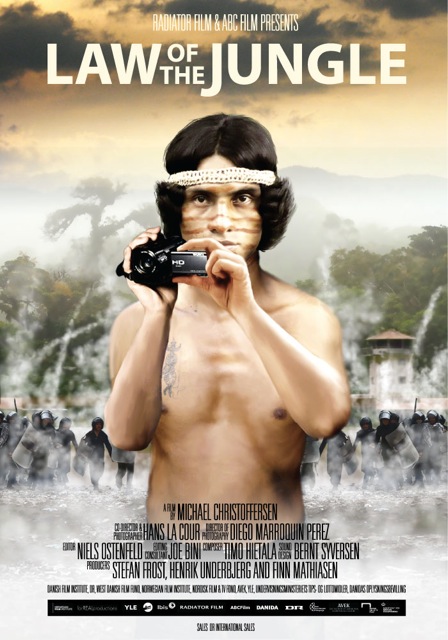
Law of the Jungle (Radiator Film in association with ABCFIlms, Fenris Film, For Real Productions) is nominated fro Best Documentary on a Contemporary Theme – International at The Grierson British Documentray Awards 2013. Directed by Michael Christoffersen, Hans La Cour