Children of the Tsunami
Two men greeted us as we pulled up in a deserted street close to the stricken Fukushima Dai-ichi nuclear plant. “Hurry, the police will spot us!” fretted Naoto the farmer, jamming his hands deeper into the pockets of his overalls. It was almost 11pm and we were running late. Naoto seemed oddly cheerful and I wondered if he was drunk (he wasn’t). The other man was grim-faced. He was a manager at the nuclear power company or one of its subcontractors and somehow had agreed to smuggle us into the heavily-policed Nuclear Exclusion Zone, a 20-km radius from which every single human being had been forcibly evacuated following the nuclear meltdown. I started to introduce myself but he cut me off: “You’ve got too much gear, why do you need all this?” Food or extra prime lenses? The lenses won, the food stayed in the back of our car, parked in the driveway of an empty house.
Then we were off, doubling through deserted back-alleys, my Indian cameraman Mrinal and I in one vehicle, my Japanese-speaking AP and sound recordist in the other. Mrinal and I donned white face-masks and baseball caps and shrank down in our seats to disguise our alien appearance as we neared the main police checkpoint on the edge of the Zone. The media was officially barred from entering, so this was our only way in. Being discovered in the back of the car would mean arrest and a $5000 fine for us, but much worse for our guide. He was putting his career on the line to get us into the Zone, yet I knew nothing about him and would never see him again.
It was the last week of our shoot for “Children of the Tsunami”, a documentary for BBC2 about the 2011 Japanese tsunami and nuclear accident, seen through the eyes of small children, and the first of our two trips into the Zone. I knew I would need images of the “dead zone” because so many of the children we’d interviewed had lived there and been forced to leave behind homes and schools at just a few hours’ notice. I also had a feeling that I wouldn’t be able to resist filming our generous host Naoto the farmer, who was one of a handful of stubborn hold-outs left inside the zone.
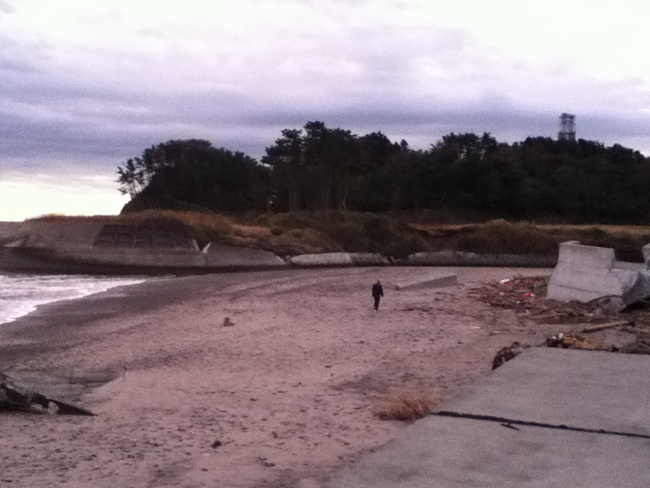
Farmer Naoto on Tomioka beach. Part of the Fukushima-2 nuclear plant can be seen peeking above the trees.
A fit, spry man in his fifties, he lived on radioactive rice harvested from his radioactive fields, washed down with plenty of sake. His only companion was a dog, though we discovered next morning that he had adopted dozens of stray pets and livestock abandoned in the zone when their owners fled. Our plan was to bed down at Naoto’s then film at sunrise in the coastal town of Tomioka, where one of our star children, 10-year-old Rikku, had lived until his abrupt departure a few months back. I had ascertained that the radiation levels at Naoto’s place would be acceptable for an exposure period of 24 hours and as we approached the checkpoint I glanced at the Geiger counter in my lap. It registered 0.3 microSieverts per hour, less than you’d absorb on a transatlantic flight.
We swung round a bend in the empty highway and a mass of blue and red flashing lights stabbed through the darkness. Our car slowed to a crawl. Policemen in white overalls and masks converged on us. Mrinal and I held our breath. Our driver flashed a permit, barked a few gruff words and suddenly we were through and into the Zone. Lighted highways patrolled by police cars soon gave way to pitch-dark side-roads littered with debris. Foliage and weeds spilled fissured the tarmac and our headlamps glanced off the windows of abandoned homes. A solitary cow loomed in front of us, then lurched off into the night. “You wouldn’t believe what goes on in here,” muttered our guide...
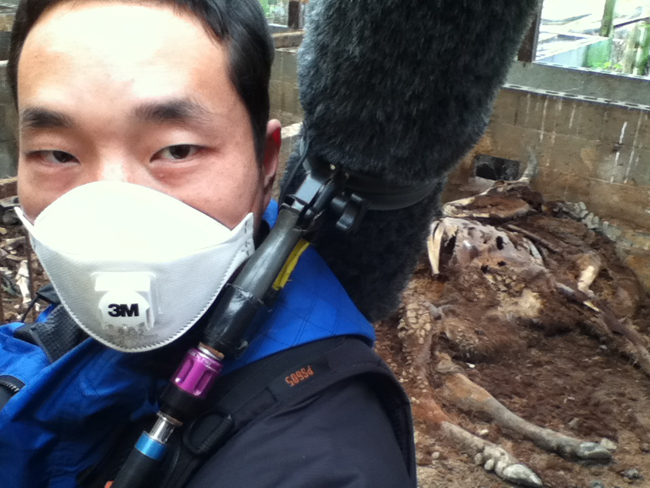
Sound Recordist Makoto Takaoka in a cattle shed inside the Fukushima Nuclear Exclusion Zone. 500 cows starved to death here.
- Children of the Tsunami (Dan Reed for Renegade Pictures (UK) is nominated for Best Documentary on a Contemporary Theme - International at Grierson 2012: The British Documentary Awards