Watch the recorded webinar here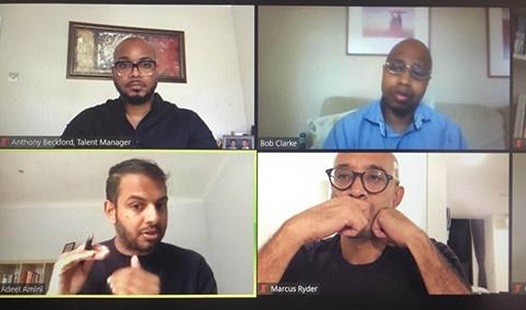
Broadcast Article by Robin Parker
Indies have ‘no excuse’ to avoid hiring from BAME backgrounds
Peer-benchmarking and a move away from unconscious bias training have been posited as the next steps in boosting the hiring and development of a diverse television industry workforce.
In an online panel organised by The Talent Manager and TV Mindset, diversity campaigner and former BBC exec Marcus Ryder said that with broadcasters’ diversity figures addressing only their own staff, it was incumbent on suppliers to make themselves accountable.
Ryder suggested that indies should either publicly or privately benchmark themselves against a comparable rival.
“If you think you’re not as good as others, you will make an effort,” he said. “You want to be better than your neighbour.”
Bob Clarke, the founder and chief executive of Mama Youth, said the “emotional investment” of training people from underserved backgrounds had been successful, with 92% of the people who have been through his scheme still in the industry.
However, he added stories that reflect diversity problems that existed when he started out 25 years ago continue to resurface.
“The moment you start putting labels on people, the pot becomes empty. You need to label talent, not diversity” - Bob Clarke, Mama Youth
“With some of the things our alumni tell us, you wouldn’t believe we’re in the 21st century,” he said. “It scares me so much to think, ‘Am I going to be seeing the same problems when I’m on my deathbed?’”
Clarke said he believed TV has a duty to correct all imbalances due to its contribution to the national discourse. “If any industry’s going to get it right, it has to be us because of our influence on society, which will directly benefit,” he added.
Ryder, is a founding member of the Lenny Henry Centre for Media Diversity, said that beyond talk of conscious or unconscious bias in recruitment, the industry needed to empower people at all levels to call out issues and make change.
“I know BAME assistant producers and directors who aren’t being given their break because everybody thinks it’s somebody else’s job to [give it to them],” he said.
Hiring issues
Ryder added he was “yet to see a production team photo for a mainstream primetime programme that shows diversity”.
He warned that while the industry accepts some programmes will fail, the desire to avoid direct criticism of their decision making in such cases could lead senior staff to consider BAME production hires as “risky”.
“Execs are trying to make sure that if anything goes wrong, they don’t get the blame,” he added.
The Talent Manager offers indies and commissioners detailed diversity reporting of their own production teams and talent networks and a diversity search engine to source the best talent from underrepresented groups.
The tools, which also include unconscious bias and job-sharing functions, have been in place for four years but Anthony Beckford, who built them, said companies’ engagement had been inconsistent until recently.
Sarah Lee, the platform’s creative director, said she is now working on getting more freelancer engagement with its diversity features as a way of putting pressure on broadcasters and producers to embed diversity monitoring in their recruitment processes.
‘Reveal the bias’
Producer Adeel Amini, who moderated the panel, reflected on the ITV research training scheme he undertook in 2008, in which five of the six participants were female and three from a diverse background.
“We thrived because of the time and investment we were given over 18 months,” he said. “My CV became so rounded that I could stay in the industry.”
Mama Youth’s Clarke said more honest, straight talking is needed to avoid decision-makers towing the company line: “Reveal the bias and deal with it,” he said.
“The moment you start putting labels on people, the pot becomes empty,” he added. “You need to label talent, not diversity.
“Having an inclusive bunch of talented people creates a much better business. It’s about showing them the ropes and them taking full responsibility for doing the job.”
Ryder said that there is now “literally no excuse” to not hire the best and most diverse people, concluding: “Diversity is a multi-billion-pound industry in itself. I want to see the day when it’s not an industry at all.”
Panellists
Adeel Amini
Adeel Amini is a freelance Senior Producer in Entertainment and Comedy. Coming from a non-TV Muslim family in Bradford, he began his career as part of ITV’s Researcher Trainee Scheme in 2008. Over the years he has worked on UK entertainment shows such as Catchphrase, Who Wants To Be A Millionaire?, Blind Date, 8 out of 10 Cats Does Countdown, and many more.
In 2018 Adeel formed what is now known as The TV Mindset, a mental health support group for freelancers based on his own experiences in the industry (and having to temporarily leave it). Alongside his job as a producer, he runs regular events to do with mental wellness, career progression, & changing industry culture, and continues to campaign for a fairer industry across the board for all freelancers. He is also a staunch campaigner for diversity and LGBTQ+ issues both in TV and outside it.
Anthony Beckford
Anthony leads the team in charge of the development and technical innovation of The Talent Manager site. He was instrumental in the creation and design of the pioneering diversity search and reporting tools. He has led the development team at TM for the last 4 years. In the past, he has worked in lead development roles for IBM and IBM business partners.
Sarah Lee
Following a successful career as an documentary producer working for C4 & BBC, Sarah Lee founded The Talent Manager in 2012 with a vision of a smarter, more equitable future for Factual TV. The Talent Manager has changed the face of industry recruitment and career development, and is now used by all of the major broadcasters and 87 out of the top 100 Indies*.
Sarah has been a long time advocate for inclusivity in TV and orchestrated the building of a suite of diversity tools starting in 2016. She supports companies that celebrate creativity, diversity and technology and is involved in a number of mentorship schemes.
*Broadcast Survey 2018
Bob Clarke
Bob has been a professional editor for over twenty years, and personally funded the first two years of MAMA Youth Project’s operation.
Bob started his television career in 1982 as a Video Tape Operator for Humphries Video Services. He went on to join The Services Sound & Vision Corporation in 1987 where he cut his teeth as an editor on different types of programming including light entertainment, news and documentaries. Following BBC training, Bob became a freelance editor and worked at various facilities in Soho, before setting up his own- bcPost.
In 1996 Bob took this facility to the next level by purchasing his first Avid Media Composer, which attracted clients such as the BBC, Endemol, Ginger Productions and Tiger Aspect. Then, in September 2005, MAMA Productions funded an experiment and recruited young adults to make an entertainment show called ‘What’s Up’. This experiment proved so successful, it led to the formation of the MAMA Youth Project.
In 2008, Bob decided to put all future commissions through the MAMA Youth Project, using talented newcomers who had worked on ‘What’s Up’. This enterprise became very successful and turned over 45,000 in 3 months. However, due to the legal limitations of a charity earning income, Licklemor Productions had to be formed – which is now MAMA Youth Project’s commercial arm.
On a personal level, Bob's great strengths are his creativity, adaptability and ability to understand what a client wants. He is also quick to recognise new talent and give them the opportunities they need.
Marcus Ryder
Marcus Ryder is a leading figure in the efforts to increase diversity and representation in the UK media industry.
In March 2020 he launched the Sir Lenny Henry Centre for Media Diversity an independent new body bringing academics and media professionals together to bring academic rigour to the practical implementation of diversity policies in the media industry.
In February 2020 he was made a Visiting Professor of Media Diversity at Birmingham City University.
He is currently based in Beijing as the executive producer of online media at Caixin Global, China's leading financial publication.
Prior to that he was head of BBC Scotland Current Affairs Programmes for eight years, executive produced BBC’s flagship current affairs programme Panorama, oversaw all of the BBC’s documentary content covering the Scottish Referendum in 2014 and launched a nightly news series.