When I set out to make Tales From the Organ Trade I thought I was embarking on a very black and white story of desperation and exploitation. There have been a myriad of films, articles and reports about the black market organ trade and most of them tell a similar story - the story of affluent first world patients in dire need of a kidney, travelling abroad to buy an organ from an impoverished, but equally desperate, victim from the third world. These black market operations take place in countries like India, Pakistan, Columbia, Egypt, the Philippines, Turkey and Russia.
We travelled around the world – to Kosovo, Turkey, Israel, Moldova the Philippines, the U.S. and Canada – and met with organ brokers, transplant surgeons, victims, recipients, lawmakers and ethicists. The picture that emerged was not a black and white story of exploitation, but rather, a nuanced and complex story that forced me to question my own moral and ethical assumptions.
Every 60 minutes, somewhere in the world, a human organ is sold on the black market. Chances are it’s a kidney. There are two reasons for this. First, kidney transplantation is an operation that has become relatively routine and therefore can be performed easily in hospitals and clinics without state-of-the-art facilities. Second, we are born with two kidneys, and if we’re healthy, we are able to survive with one.
We all intuitively feel that purchasing a kidney is wrong. The general consensus from the medical establishment, from the World Health Organization, from medical ethicists and the community at large, is that buying an organ is exploitative. News reports describe these transactions as coercive and unethical. Terms like organ harvesting, kidney cartels, cannibalism, etc., are scattered throughout these reports. And without any analysis or context that would be the end of the story. But there’s a more complicated story to tell that digs a little deeper and doesn’t have as resolute a point of view. I wanted “Tales from the Organ Trade” to tell that story.
This is a story where the villains often save lives and the medical establishment, helpless, too often watches people die.
To be clear, this is a very different issue than the stories emerging from China where they are executing prisoners for their organs. Or in villages in India where moneylenders are forcing their debtors to sell their kidneys to repay them. These are not ethically ambiguous circumstances. But most of the organ trade takes place in the more ambiguous world of desperation on both sides of the equation.
There are no legal ambiguities in the organ trade. It’s illegal to buy or sell a kidney. Period. But my experience making the film was a real emotional and ethical roller coaster. I think that the black market has to be shut down – as a “black market.” The black market potentially leaves both the organ sellers AND the recipients vulnerable to abuse and to sub-standard medical practice. What threw me off while filming was the sudden realization that, for some people, selling a kidney might, in fact, help them out of a life of relentless subsistence existence. At one point during the shoot we were following a young man trying to sell his kidney. His dream was to move out of the urban slum where he and his wife and young child live in a borrowed hut, into a small house in a rural area where he could farm and raise chickens. The kidney broker he was working with got scared by our cameras and, at the last minute, told him the operation was cancelled. In fact, she had switched to another donor with the same blood type. Instead of feeling like I had saved him, I felt like I had robbed him of what might be his only chance to better himself. I was surprised at my own feelings and that’s when I decided that I wanted to take viewers on the same ethically ambiguous journey I took while making the film.
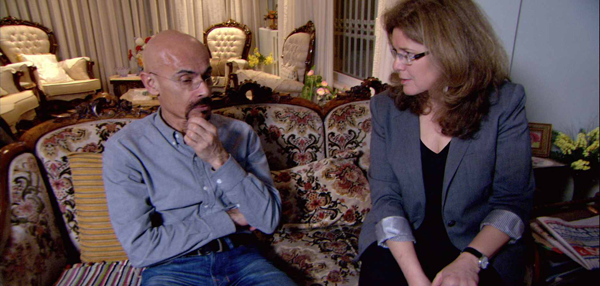
Besides the organ sellers, you have to spend time with people in desperate need of a kidney to truly understand what would drive someone to seek out a black market transplant. As one of the characters in the film says “life on dialysis isn’t living…it’s existing”. I never really understood how devastating it is to be on dialysis until I spent time with people who are enduring the purgatory of this process. It keeps you alive but it sucks the life out of you.
Finally, for me, the heart of the film is the Medicus story. The Medicus clinic in Kosovo was at the center of the world’s most notorious organ trafficking prosecutions. As I immersed myself in the world of organ trafficking, I became increasingly curious about the teams of people who operate across international borders and how they all come together to perform an illicit organ transplant. The Medicus case is truly international; the recipients all came from foreign countries. There were surgeons and doctors and brokers involved from across the globe. My goal was to track down all the players from one single operation – the nephrologist, the surgeon, the recipient, the broker and finally, the prosecutor trying the case – and see the world of organ trafficking through all of their differing perspectives. A kind of black market organ trade Rashomon! I think putting faces to all the players
If there’s one message that I hope the film succeeds in delivering, it’s that this is a complex issue, often sensationalized in the media. We can only succeed in shutting down the black market if we find solutions for those in need of a transplant, and opportunities for those who desperately need the money. This film is as much about poverty as it is about the organ trade.
Tales from the Organ Trade is nominated for 'Best Documentary on urrent Affairs' at the 2014 Grierson Documentary Awards