Frontline Medicine
It was Friday the 13th, May 2011, and we’d been filming for a week in the main hospital in Camp Bastion, the headquarters of the British forces in Afghanistan. It was surprisingly quiet for what is usually one of the busiest trauma hospitals in the world. We were told it was the calm before the storm, that the Taliban were bringing in the last of the poppy harvest and when that was done the real fighting would start.
Mid morning and helicopters carrying the wounded began to land near the hospital. One of the first to be brought in was 20 year old US Marine, Lance Corporal Ronald Barnes. Ronald had been blown up by an IED, an Improvised Explosive Device, which had taken off both of his legs. He had lost massive amounts of blood. Over the next few hours we filmed the medical team use all the vast experience they have painfully acquired over recent years to save his life.
The survival rate amongst wounded troops is the highest in the history of warfare. Up to 90% of casualties are kept alive. It was that incredible statistic that led us to make the two-part documentary series, Frontline Medicine. We wanted to find out what they were doing that was making the difference and how what was being learnt could be used to improve trauma care in the UK.
It took 18 months to secure access from the MOD. There’s normally a blanket ban on filming casualties in critical care. Once we’d achieved ministerial sign off and the permission of the Surgeon General that was just the start of our negotiations. It was the medical team who would be running the hospital while we were there that were most reluctant.
We won them round by doing our research, asking informed questions and being genuinely interested in what they had learned professionally in the extreme situation of Camp Bastion. One of the Consultants told me that they were proud of what they were achieving but no journalists had shown any real interest before. The staff wanted us to be able to tell that story as well as possible. That was the key to our access.
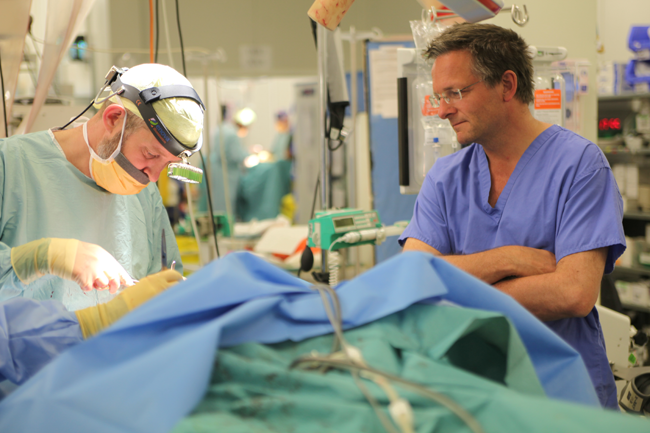
Plastic surgeon Commander Rory Rickard with presenter Michael Mosley
I was impressed by the medical innovations. I was, perhaps naively, surprised that they had state-of-the-art equipment. This was most certainly not the conditions of MASH. Yet, it was the humanity and resilience of the medics that made the biggest impression on me.
It was a profound experience to see the way the medics looked out for the psychological welfare of each other. They showed the same compassion towards ourselves. There were many bloody and horrific sights but it was the ones where I made the emotional connection with the lives that were being destroyed that were most difficult. Medics talked about the demons that stayed with them from every tour. They would be fine 95% of the time but there were always a handful of cases they couldn’t escape from.
When our presenter, Michael Mosley, asked one of the surgeons how he coped – he said “Well if you start by thinking we didn’t give them the injuries, we’re only trying to make them better then you can just about deal with it.”
I think about the hospital at Camp Bastion regularly. One of the most sobering reflections is that we were only at the hospital for a short time – the constant stream of badly injured young men and women has never stopped since we left.
- Frontline Medicine: Survival (Paul Overton for BBC Scotland) is nominated for Best Science Documentary at Grierson 2012: The British Documentary Award