It was the telephone call for which I'd waited a decade. As soon as Prof Geoff Raisman said the words "we've done it!" I knew he'd fulfilled his life-time's ambition - reversing paralysis. It also meant the BBC and Panorama were on the brink of a world exclusive.
I'd known Geoff for years and reported on his research. He had spent 40 years trying to show that specialist cells in the nasal cavity - part of our sense of smell - could be used to provide a bridge to enable the spinal cord to repair itself. The so-called olfactory ensheathing cells (OECs) are the only part of the central nervous system which continually renews itself. Geoff had achieved promising results in animal trials and whenever we met told me that he wanted me to tell the story. I never doubted his sincerity or his scientific credentials, but I was still astonished when he told me what had been achieved.
For Panorama the task was how best to tell the scientific and human stories behind the historic breakthrough. Professor Raisman from University College London had teamed up with a young neurosurgeon in Poland, Pawel Tabakow. The third key member of the team was the patient, Darek Fidyka. He was paralysed from the chest down in a knife attack in 2010.
Producer Alison Priestley, cameraman Jon Stapleton and I made several trips to Wroclaw to chart Darek’s progress following the surgery to transplant the cells from his nose into his severed spinal cord.
Seeing Darek walk a few tentative steps using a frame was an astonishing moment, which we were there to witness. Geoff told him “What you have achieved is more impressive than man walking on the moon.” As Darek’s confidence and abilities grew we filmed an even tougher test when he walked outside, over a wooden bridge.
Each time we brought the rushes back and showed Darek’s progress to Panorama executive producer Frank Simmonds there was a sense of excitement in the office and recognition that this could be of profound importance to other patients.
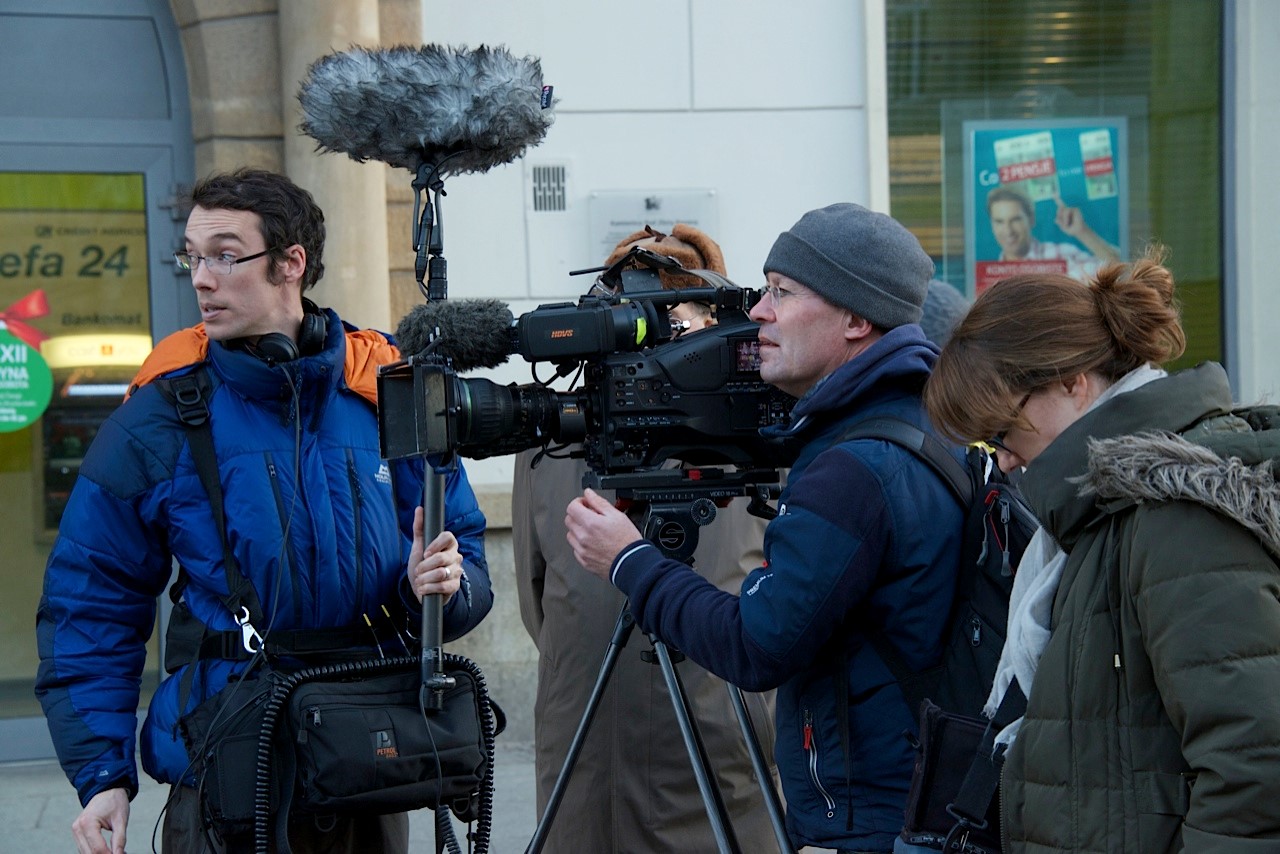
For us the film was about scientific endeavour, determination and hope. We needed to explain the science behind the astonishing feat. For years Prof Raisman had been a maverick, a scientific outsider, often dismissed by the establishment. Yet now he had been proved right. In Dr Tabakow he saw a kindred spirit – a brilliant surgeon who not only believed in him, but had the backing of senior colleagues to try the technique in patients. Then there was the utter determination of Darek Fidyka who had to devote himself to a punishing schedule of rehabilitation – hour upon hour spent in the gym learning to walk again.
There was another personal story we wanted to tell – that of British chef David Nicholls, whose son Daniel was paralysed in a swimming accident when he was 18. David had made his son a promise that “We’re going to make you better; we’re going to fix you”. He set about raising millions in pursuit of the dream of curing paralysis, funding the research in Britain and Poland.
Darek’s achievement (which was simultaneously published in the scientific journal, ‘Cell Transplantation’) has paved the way for an international clinical trial. Only once that has been completed will scientists know the full potential of the nasal cell transplant. But Darek, a charming, gregarious man, is in no doubt. For him walking again is “incredible – like being reborn”.

Panorama: To Walk Again is nominated for Best Science or Natural History Documentrary at The Grierson Awards 2015.
Alison Priestley for BBC; first shown: BBC One