Beginning my film SEPIDEH in a time where George Bush’s proclaimed war against the axis of evil still echoed around the world, I knew that setting a film in Iran inevitably would add a framing of or add images to the film in peoples’ minds. Who doesn’t know the countless clips in the global media of black-clad women and men, standing with fists in the air while shouting out their opposition to the West.
Shortly after, the Green Revolution in the aftermath of the Iranian 2009 presidential election exposed images through Twitter and other social media of protesters and young people in the streets of Tehran demonstrating against the regime, making the world aware of another side of Iranian society.
But what kind of Iranian reality and lived life exists between and beneath these broad strokes?
I started out filming SEPIDEH out of simple necessity. I literally bumped into Sepideh one dark night in South Iran, far away from the streets of Tehran and the spotlight of global media. She was 14 years old at the time. Her life was already tied to her amateur telescope and her longing for one day to float around in the vast universe as an astronaut was as strong as her will to fight for her dream. I realised that I had no choice but to follow her to see how she would manage insisting on deciding over her own life. There was something that burned inside her, something that I had to explore further.
The strength of documentary filmmaking is our ability to dive down from the broad and generalized portrayals that often confirm stereotypes or are driven by politicised interests. But I don’t believe in the adequacy of a pure wish to “show a different side of” prevailing images. At worst these counter-stories result in equally stereotypical images. It presupposes that we are dealing with rigid patterns or fixed social positions and oppositions – and human life and its social world rarely unfolds in such simplicity.
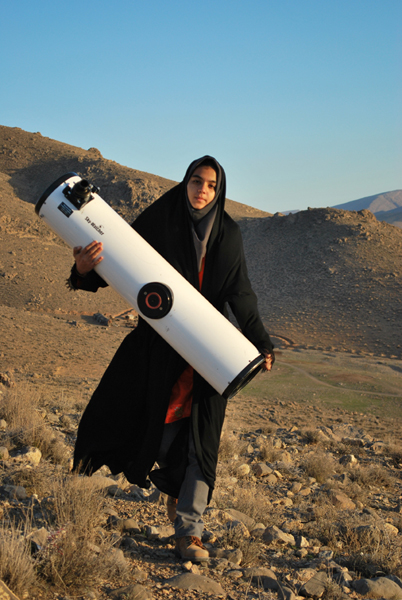 I knew Iran for a long time before starting up SEPIDEH because my husband is Iranian and I was familiar with its complex social dynamics. But still, the very first days I spend with Sepideh should become an important guideline for me for what I was to pursue in the following five years of making the film. The girl I met looked like any other girl in the province, dressed in her black chador and performing proper standdards for a young Iranian girl's behavior and apperance, only her heavy military-like boots sticking out under her dress revealed that something else was going on. Sepideh was not the girl who marched in Tehran with the scarf pulled far down the neck but the first sneak peek into her diary to late Albert Einstein, her great hero, gave the first access to the inner world of girl who through the science of astronomy and a desire to understand the universe had found her own way to question the order of the world and her own life. I met a girl balancing on the knife’s edge. And in her close social environment I met family members who seemed to tread on each other's toes in their attempt to stop Sepideh in pursuing her dream of becoming a great astronomer and replace her nightly stargazing with a less challenging behavior, but who rather than being antagonists were people whose motivations and actions I had to find my way to understanding.
Entering a social landscape in Iran that refused to be one-dimensional gave me a commitment to deal with the intimate access I had to Sepideh and the most important people around her with care. To look behind the façade, without a filter, where real people live for better or worse without being good or evil, but living people.
During the five years of making SEPIDEH, the Middle Eastern region as we thought we knew it started to fall apart. I felt a growing need of informed grand political analysis to understand what’s going on and I felt an urge to move and to be taken beyond the headlines and access the complex, and sometimes seemingly contradictionary motivations and inciments that form the way people handle their lives in a very concrete way.
I never intended to turn Sepideh into an example of dynamics among young people in Iran as such. She is an inspiring individual and I wanted to work my way into a description of the person Sepideh, holding on to my curiosity about her hopes, wishes and her special will as it could be reflected in a more personal story. Sepideh is a look into a female teenagers tiny huge world and her fight for her dream. I can only hope that I managed to open a crack in a door into a small corner of tomorrow's Iran.
Finally I have to mention that making a film in Iran these years and over such a long period of time is difficult. But my producers and I have been blessed with an incredible skilled team of Iranian filmmakers that has fought for this film for Sepideh and for us both with passion and professionalism all the time. We could not have made this film without them.
SEPIDEH is nominated for 'Best Documentary on a Contemporary Theme – International' at the 2014 Grierson Documentary Awards