I think as programme makers there is a little bit of the control freak in all us, a desire to wrestle order and structure on a world of chaos and unpredictability.
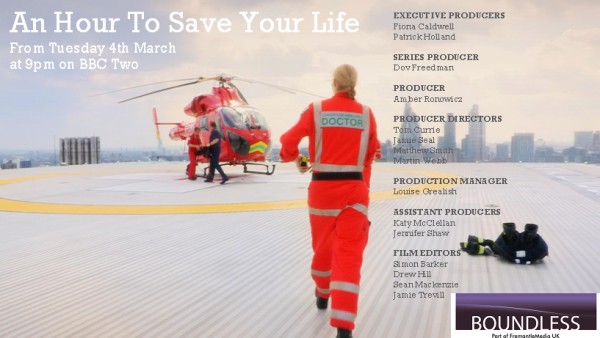
With that in mind, as a production team making AHTSYL arguably presented the greatest challenge.
The premise of the series was simple enough. BBC2 wanted us to give the audience a 360 view of the “golden hour” the most critical 60 minutes after a major accident where every single moment for the patient can mean the difference between life and death.
Simple enough in theory – however putting that on screen was anything but.
We negotiated access to three NHS trusts across the country in London, Birmingham and Nottingham, and then each of their associated air and land ambulance services.
Each of our three locations was staffed by a team consisting of two shooting Producer/Directors, a consent Producer, and a data wrangler to manage the unpredictable flow of material. One of the PDs would cover the pre-hospital shifts, usually on the air ambulance, and then handover the story to the second waiting PD at the receiving hospital.
We made the conscious decision to have this tag team approach because covering these stories was extremely challenging both physically and emotionally for the PDs. So handing over the baton on arrival to hospital allowed the whole team to maintain a real rigour and focus in capturing the unfolding drama within a compressed window of time.
As well as shooting on the C300 and the Canon XF-305 our stories developed so quickly that we also had to rely heavily on the Go-Pro Hero Cam (3). We rigged them where ever we could, but because of our strict consent protocols, mounting them as body cams on clinicians is where they really came into their own.
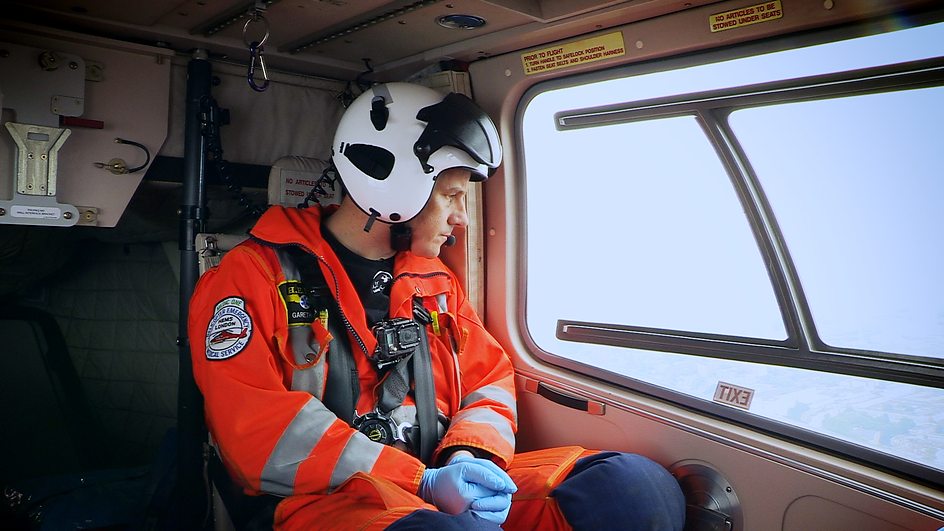
London's Air Ambulance at the scene - An Hour To Save Your Life, BBC Two
When arriving at the scene of an accident, our PDs would have to wait until the lead clinician gave them permission to start filming, at which point they would utilise the Go-Pros in-built Wi-Fi, switching them on remotely via an app on their phone without interrupting any of the patients vital treatment. This technique really helped our teams to embed with the emergency services and I think that’s really reflected in the quality and intensity of the material they captured.
Some of our patient stories were shot on a total of 8 different cameras, so it was essential that we had a good data flow system in place. Synching all our cameras at the start of each shift, to shoottime of day was imperative and enabled us to forensically unpick each story, moment by moment once in post-production, and interweave each patient’s real time narrative.
We tried to put as many systems and protocols in place before filming began. For instance we took the decision to shoot the series during June and July, giving us the most daylight hours and therefore the most flying hours with each of the air ambulances services. But there was only so much preparation and planning we could put in place, we really were at the mercy of the unexpected.
We could never predict how stories would unfold and how complex some of the consent issues surrounding each case would be. With our whole editorial interest focussed on this first 60 mins of care it was inevitable that a huge percentage of our material would end up not being used.
Although the material can be quite graphic, we were making a series from the clinician's point of view so I think it was right that we showed the extreme situations in which they discovered and treated patients...
Watch Episode 1 of An Hour To Save Your Life on BBC iPlayer